


Hello, I’m Mandeep. Welcome to my Watch and Learn English substack. My aim is to teach “real-life” English using videos and topics that are in the news.
What’s on this week?
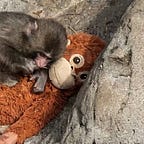
This week, we look at a story that has been shared across social media: a baby Japanese macaque called Punch at Ichikawa City Zoo near Tokyo.

Punch the monkey with his plushie. (Source: Instagram/@punch__monkey)
Born last July and rejected by his mother, Punch was raised by zookeepers before being carefully reintroduced to the troop. Given a soft orangutan toy for comfort and strength-building, he quickly became attached to it. Clips of him carrying and cuddling the toy have gone viral.
That connects directly to our language focus this week.
Because news stories often use participle clauses to make descriptions more natural and less repetitive.
This week we explore how participle clauses work, where they are used, and why they are so common in storytelling.
This week we have:
Video of the week – a short news clip about Punch
Grammar focus – participle clauses
1. Video of the week – Punch
This week’s video introduces Punch, a young Japanese macaque living at Ichikawa City Zoo near Tokyo.
Punch was born last July, but his life began in a difficult way. His mother rejected him shortly after birth, so he had to be cared for by the zoo staff. For several months, most of his contact was with humans rather than other monkeys.
When he became a little older, the zoo began the careful process of introducing him to the rest of the troop on the zoo’s “Monkey Mountain.” This can be challenging for young macaques, especially for one who did not grow up with his mother helping him learn how to behave socially.
To give him comfort and something to hold onto, the keepers gave Punch a plush orangutan toy. He quickly became attached to it and began carrying it everywhere. Videos of him hugging and dragging the toy around the enclosure spread quickly online and attracted millions of views.
More recently, things seem to be improving for Punch. New footage shows him spending more time with other monkeys his age and even being groomed by members of the troop, which is an important sign of social acceptance.
As you watch the video, notice how the story of Punch is told using short descriptive phrases. Many of these are participle clauses, which we will look at in the language focus section.
🎬 Watch with subtitles you can trust — and click any word to learn more.
You can click here to watch the video for free with clear, accurate captions (not auto-generated) and even slow the playback to catch every word.
If you’d like to go deeper, click on any word in the subtitles. With unlimited access (€1.99/month), you’ll get:
Words and phrases explained in context
Comprehension exercises
Mobile-friendly study on your phone
A weekly vocabulary summary to help you remember what you’ve learned
2. Grammar Focus: Participle Clauses
Participle clauses are very common in news reports and storytelling. They allow us to add background information without creating many short sentences.
Instead of saying:
Punch was born last July.He struggled at first.
We can combine the ideas:
Born last July, Punch struggled at first.
The first part gives background information. The main clause tells us the important action.
You will often see participle clauses at the beginning of sentences in news articles, documentaries, and biographies because they help writers move the story forward smoothly.
There are two main forms.
1️⃣ Past participle clauses
Past participle clauses usually describe something that happened to the subject.
Born last July, Punch struggled at first.
Rejected by his mother, he was raised by zookeepers.
Given a plush toy for comfort, he quickly became attached to it.
In each case the participle introduces background information about Punch before the main action of the sentence.
These clauses replace longer sentences such as:
Punch was born last July.
Punch was rejected by his mother.
He was given a plush toy.
Using participle clauses makes the story flow more naturally.
2️⃣ -ing participle clauses
The -ing form usually describes an action happening at the same time as the main clause.
Carrying the toy everywhere, Punch became famous online.
Watching the videos, people felt emotional.
Trying to connect with the older monkeys, he kept approaching them.
These clauses show actions connected to the main event.
One important rule
The subject of the participle clause must be the same as the subject of the main clause.
Correct:
“Born last July, Punch struggled at first.”
Incorrect:
“Born last July, the zookeepers cared for him.”
This second example suggests the zookeepers were born last July, which is not what we mean.
Why this structure is useful
Participle clauses help us describe events clearly while keeping sentences shorter and more natural. They are especially useful when telling stories or describing a sequence of events.
That is why you see them so often in news articles and documentaries.
🎧 Extended Audio: Watching Punch online
Now listen to a longer example. Notice how participle clauses are used naturally to tell the story.
Scrolling through social media last night, I came across a video of a baby monkey hugging a toy. Born last summer and rejected by his mother, Punch had been raised by zookeepers before joining the troop.
Given a plush orangutan to hold, he started carrying it everywhere. Watching him drag the toy around the enclosure, many people felt both happy and sad at the same time.
Rejected at first by some of the older monkeys, he kept trying to approach them. Seeing the newer videos, showing him being groomed by another monkey, it seems like he is finally being accepted by the group.
Carrying his toy and exploring the enclosure, Punch has become one of the most loved animals on the internet right now.
Final Thought
Stories like Punch’s travel quickly online, shared across news sites and social media within hours. Written for a wide audience, they often rely on clear and efficient grammar.
Participle clauses are one of the tools that make that possible. They allow writers to add background information while keeping the story moving.
Once you start noticing them, you’ll see them everywhere — in news articles, documentaries, and even longer stories.
Try using one yourself this week when describing a past event
Say hello
Please let me know what you think of my post. Your feedback is appreciated.
Loved it | Great | OK | Meh | Bad
We have 22.000 subscribers in 123 different countries! Please come and say hello to everybody in the comments. I’d love to know what you’re watching this week.


